
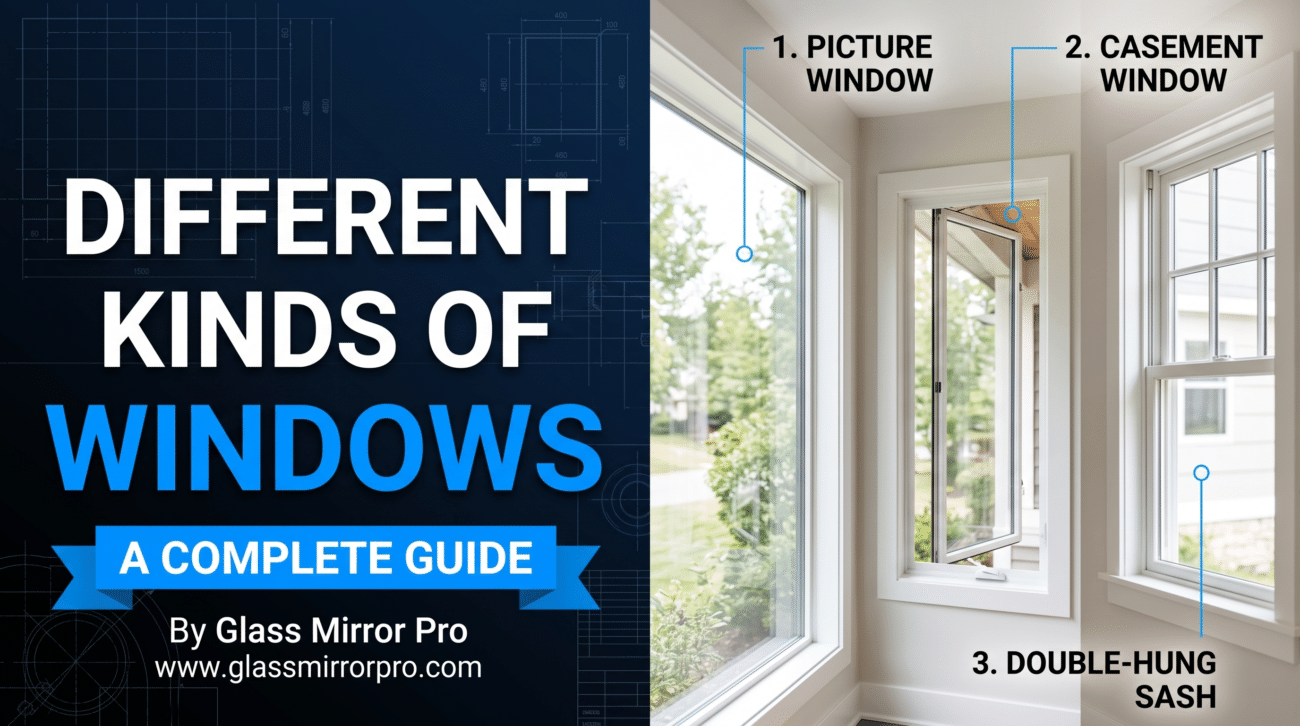
Different Kinds of Windows: A Complete Guide to Styles and Functionality
Published by Glass Mirror Pro | Expert Glass & Mirror Solutions
Windows are the eyes of your home. They dictate how much natural light floods your living room, how well your house is ventilated during the summer, and even how much you spend on heating and cooling throughout the year. But with so many architectural styles and operating mechanisms on the market, choosing the right replacement windows can be incredibly overwhelming. Do you need the classic charm of a double-hung window, the airtight seal of a casement, or the expansive view of a picture window? In this comprehensive guide, we will break down the different kinds of windows to help you make the perfect choice for your upcoming renovation.

1. The Classics: Single-Hung & Double-Hung Windows
If you live in a traditional American home, you likely have hung windows. A single-hung window features two sashes (the framed glass panels), but only the bottom sash slides vertically to open, while the top remains fixed. They are cost-effective and very common in new construction. A double-hung window, however, allows both the top and bottom sashes to slide up and down independently. This offers superior ventilation (hot air escapes out the top while cool air flows in the bottom). Plus, modern double-hung windows feature tilt-in sashes, making it incredibly easy to clean the exterior glass from the comfort of your living room.
2. Maximum Airflow: Casement & Awning Windows
Unlike hung windows that slide on a track, casement windows are hinged on one side and swing outward like a door using a hand crank. Because the entire window pane opens, they offer the maximum possible ventilation and an unobstructed view. Even better, when locked, the sash presses tightly against the weatherstripping, making them one of the most energy-efficient operating windows available. Awning windows operate using the same crank mechanism, but they are hinged at the top and open outward from the bottom. This creates a glass “awning,” allowing you to leave the window open for fresh air even during a rainstorm.
3. The Views: Sliding & Picture Windows
If you have a wide wall space where an outward-swinging casement would get in the way of a patio or walkway, a sliding window is the perfect solution. Think of it as a double-hung window flipped on its side; the sashes glide horizontally along a track. They are incredibly easy to operate and perfect for hard-to-reach places like above a kitchen sink. Conversely, if you want the ultimate view and don’t need ventilation, a picture window is the way to go. These are large, fixed (inoperable) panes of glass. Because they have no moving parts or gaps, they provide the highest level of energy efficiency and security while letting in massive amounts of sunlight.
4. The Glass Matters: Insulated and Safety Glazing
No matter which style of window you choose, the quality of the glass inside the frame dictates its performance. Modern homes require double-pane or triple-pane Insulated Glass Units (IGUs). These windows trap a layer of dense argon gas between the panes to prevent heat transfer. Furthermore, upgrading to a Low-E (low-emissivity) glass coating will block harmful UV rays from fading your furniture while keeping your home cool in the summer. If your window is located near the floor, a door, or in a bathroom, building codes require it to be fitted with heavy-duty tempered safety glass to prevent dangerous shattering.
Find the Perfect Custom Glass for Your Windows
Whether you are fixing a broken pane in a classic double-hung window or upgrading to an energy-efficient Low-E picture window, you need high-quality glass that matches your home’s exact specifications. Don’t settle for drafts and foggy panes! The professionals at Glass Mirror Pro precision-cut and deliver premium replacement window glass tailored perfectly to your unique project.
Idea: An interactive trade-off comparator allowing users to filter window types based on ventilation needs, energy efficiency, and cleaning ease.
Visual type: Filterable Comparison Table / Cards
Data specification:
– Data structure: An array of window types containing attributes (Style, Ventilation, Energy Efficiency, Cleaning Ease, Best Use Case).
– Initial values:
– Double-Hung: Ventilation: Medium | Efficiency: Medium | Cleaning: Very Easy (Tilt-in) | Best For: Traditional Homes
– Casement: Ventilation: High | Efficiency: High (Airtight seal) | Cleaning: Easy | Best For: Maximum Airflow
– Sliding: Ventilation: Medium | Efficiency: Medium | Cleaning: Harder (tracks) | Best For: Wide wall spaces
– Picture: Ventilation: None | Efficiency: Very High | Cleaning: Exterior only | Best For: Large expansive views
– Awning: Ventilation: Medium | Efficiency: High | Cleaning: Exterior only | Best For: Rain-proof ventilation
– Mapping: Renders as side-by-side metric cards displaying the pros and cons of each window configuration.
User controls:
– Toggle: “Top Priority” (Maximum Ventilation / Highest Energy Efficiency / Easy Cleaning)
Interactivity: Toggling the user priority control highlights and filters the displayed cards to show the window styles that best match the selected requirement.
Animation: Smooth fade-in/fade-out transitions when filtering the window style cards.




Leave a comment